
Behind the scenes at Lens Roses
If you’ve ever passed by a rose field in July, you might have seen it: people bent over young rootstocks, a sharp knife in hand, carefully making a small incision in the bark. What they’re doing is called budding – a traditional yet efficient way of propagating roses.
But what exactly is budding? Why do we do it, and how do we approach it at Lens Roses? We reveal it all in this blog post.
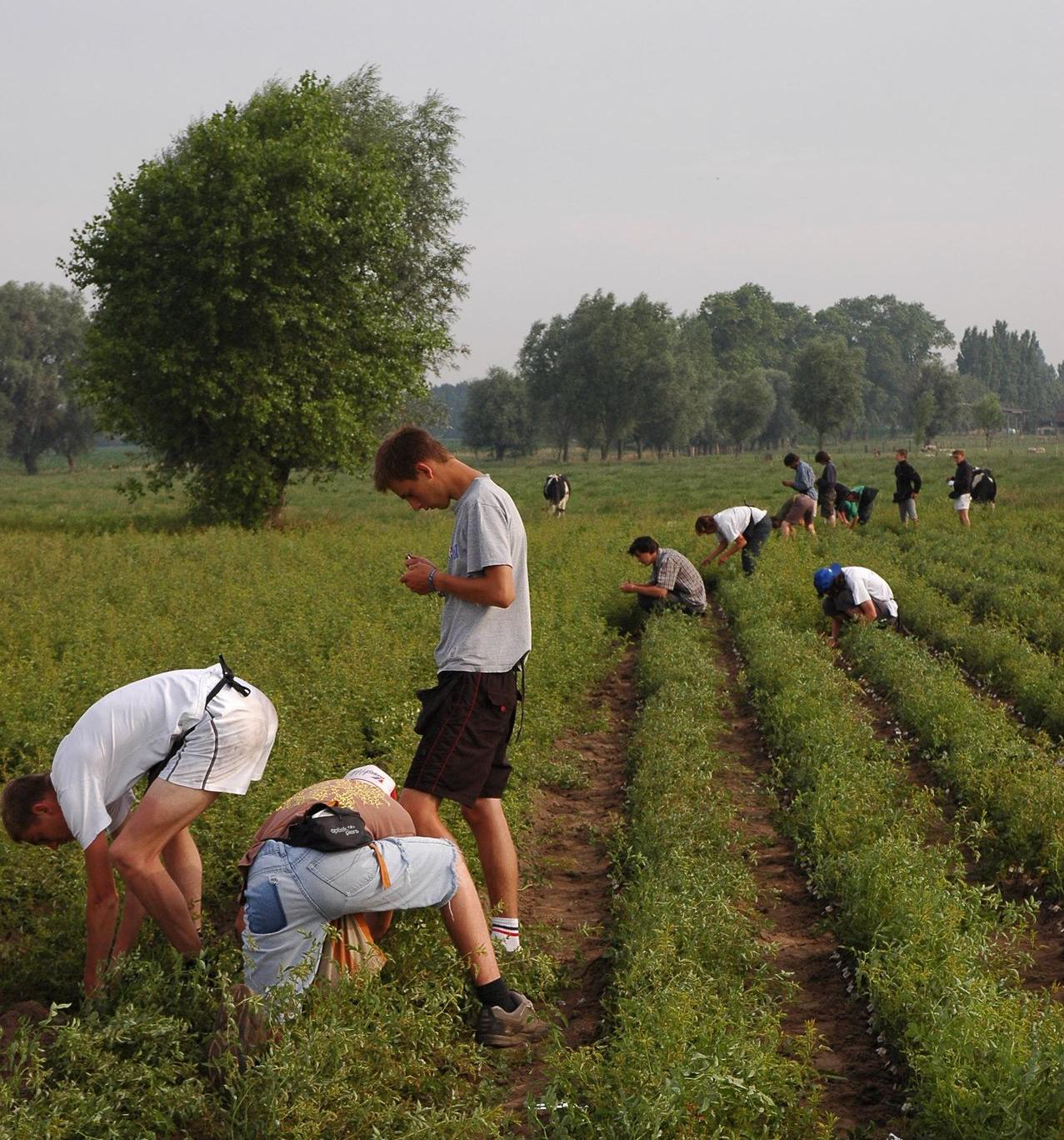
Row by row, all our roses are carefully budded and tied.
1. What is budding?
Budding involves inserting a single bud (eye) from a chosen rose variety onto a rootstock. From that one bud, a new plant will grow, carrying all the traits of the variety you wish to propagate.
It’s a form of vegetative propagation: you’re essentially “cloning” the rose, ensuring true-to-type plants every time.

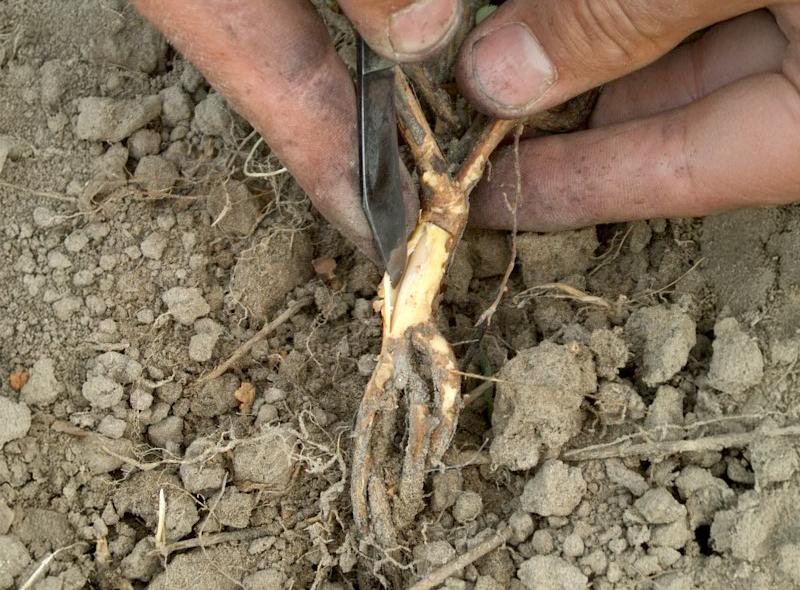 Make an incision in the rootstock collar
2. Why do we propagate roses by budding?
Not all roses grow with the same vigour, disease resistance or adaptability to different soils. By budding onto a strong, healthy rootstock, you get:
- Strong growth
- Uniform quality
- Faster development to the desired plant size compared to cuttings
- A bare-root rose – perfect for planting from November to early April
Budding is especially suited to outdoor field cultivation. And if you want to produce standard (stem) roses, budding is essential – the bud is placed exactly at the desired height on the stem.

 Shrub rose budded at the root collar
3. Budwood: how we harvest and store it
To perform successful budding, you need healthy, fresh budwood from the roses you wish to propagate.
At our nursery, we harvest this budwood directly from our rose fields during the month of July. We select young, well-developed shoots with nicely formed buds at the ideal stage of ripeness. After cutting, the leaves are removed, the shoots are labelled by variety and wrapped in moist newspaper.
We also offer budding on request.
Do you have a rose with sentimental value but no longer remember its name? No problem: if you provide us with the budwood around mid-July, prepared as described above, we’ll propagate it for you with care. That way, your beloved rose can live on.
The budwood is then stored in a refrigerator at low temperature and high humidity to keep it fresh until budding – usually within 24 to 48 hours. This allows us to work at a steady and controlled pace without compromising quality.

 Harvested shoots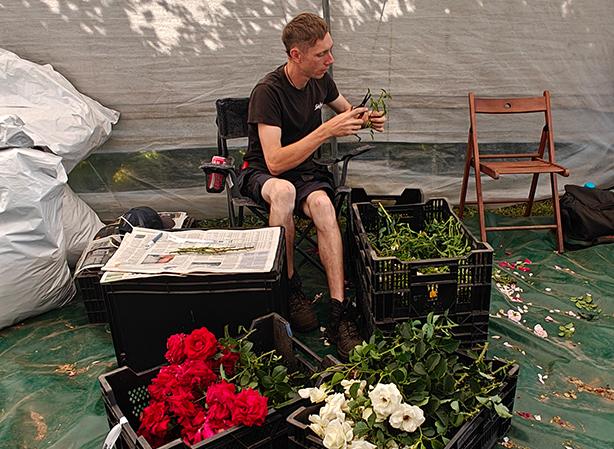
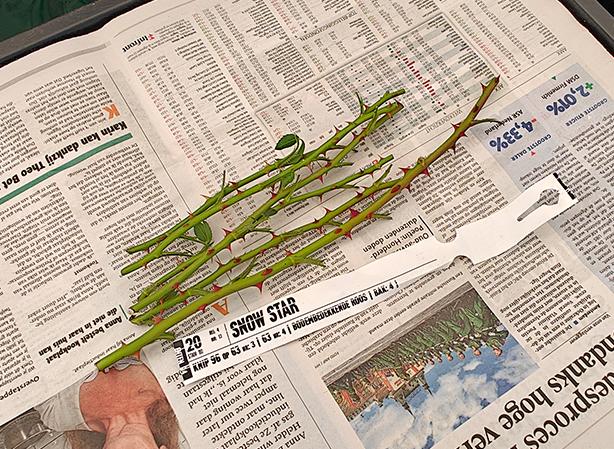 Budwood ready for packing
4. How does budding work?
Curious how rose budding is done in practice? Here's a step-by-step explanation: you start by making a T-shaped incision in the bark of the rootstock. Then you cut a small shield-shaped piece from the budwood, containing a well-developed eye. This bud is gently slipped under the bark flaps of the rootstock and tightly secured with a biodegradable budding tape.
The plant then enters dormancy for the winter. In spring, the rootstock is pruned just above the bud, encouraging the bud to sprout into a new rose shoot. This young shoot is pinched several times to encourage good branching at the base.
Want to see it in action? Be sure to watch the video where Rudy demonstrates this precise technique in the field.
5. Which rootstocks do we use?
The choice of rootstock has a major influence on the vigour, soil adaptability and final shape of the plant. At Lens Roses, we carefully select our rootstocks according to their intended use:
- Rosa canina ‘Schmidt’s Ideal’ – vigorous, well-branched, ideal for our Moschata hybrids.
- Rosa canina ‘Pfaender’ – robust, with fine root development, popular for standard roses and rugosa types.
- Rosa corymbifera ‘Laxa’ – strong, lime-tolerant and compact-growing, a reliable all-rounder.
- Rosa multiflora – well-suited to our miniature roses.
By choosing the right rootstock for the purpose, we ensure that each rose grows in the best possible way – whether it’s a delicate miniature or a majestic climber.
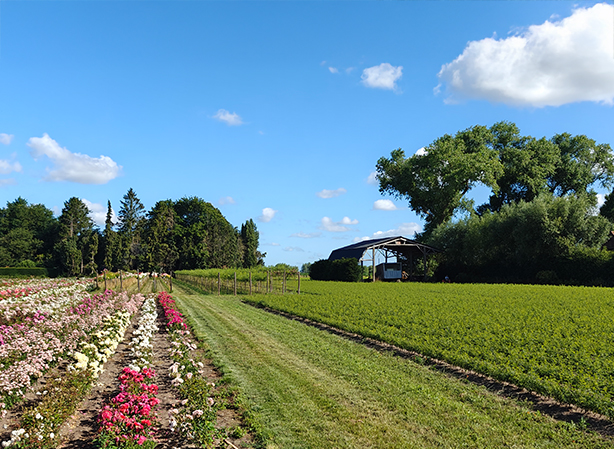
Left: field in bloom
Right: new field with rootstocks
6. Conclusion
For us, budding is one of the most important moments of the year. In just a few intense weeks, we lay the foundation for the next generation of roses. It takes precision, experience and perfect timing – but without this step, there would be no harvest, no collection, no new plants.
Once the budding work is done, we take a step back. It’s the perfect time to catch our breath, let the fields rest a little… and seek inspiration in gardens beyond our own.