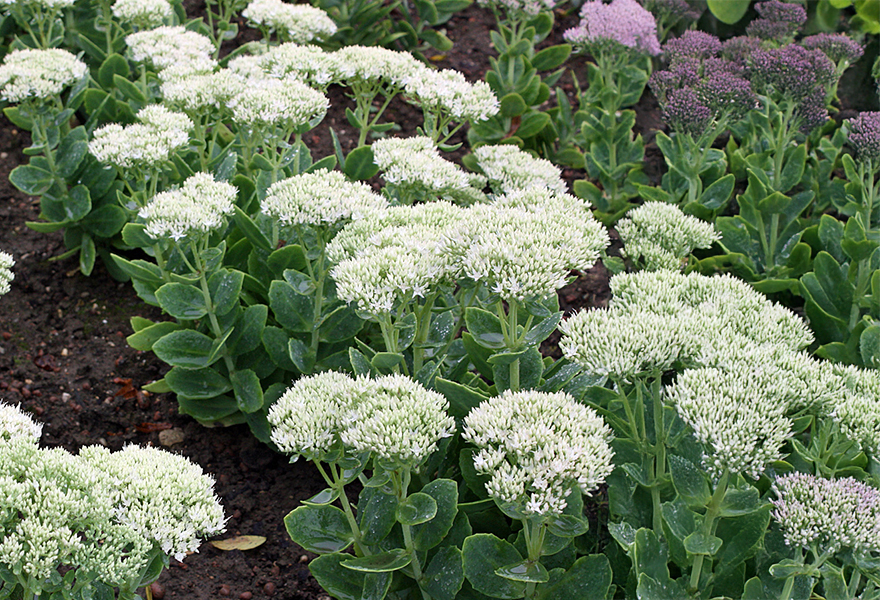
Sedum spectabile 'Stardust'
Sedum spectabile 'Stardust' is a white-flowered stonecrop that blooms in late summer and attracts pollinators. Best suited for sunny, well-drained spots and low-maintenance borders.
Sedum spectabile 'Stardust', also listed under Hylotelephium spectabile 'Stardust', is a hardy and low-maintenance perennial with a clump-forming, upright habit. It grows to about 40–50 cm in height and features fleshy, grey-green leaves along thick, sturdy stems. The plant is especially noted for its flat-topped clusters of pure white star-like flowers that appear from August to October, attracting bees and butterflies in abundance.
This sedum thrives in full sun and prefers well-drained soils that range from dry to moderately moist. It performs particularly well in sandy, gravelly, or even poor soils, making it ideal for drought-tolerant gardens, rockeries, or as a structural filler in perennial borders.
Care is straightforward: simply cut back the dead stems in early spring. Avoid overfeeding, as rich soil may cause the stems to flop. 'Stardust' is fully hardy and returns reliably year after year with minimal input.
Ecologically, the plant is an excellent nectar source for pollinators late in the season when fewer flowers are in bloom.
Sedum spectabile 'Stardust', also listed under Hylotelephium spectabile 'Stardust', is a hardy and low-maintenance perennial with a clump-forming, upright habit. It grows to about 40–50 cm in height and features fleshy, grey-green leaves along thick, sturdy stems. The plant is especially noted for its flat-topped clusters of pure white star-like flowers that appear from August to October, attracting bees and butterflies in abundance.
This sedum thrives in full sun and prefers well-drained soils that range from dry to moderately moist. It performs particularly well in sandy, gravelly, or even poor soils, making it ideal for drought-tolerant gardens, rockeries, or as a structural filler in perennial borders.
Care is straightforward: simply cut back the dead stems in early spring. Avoid overfeeding, as rich soil may cause the stems to flop. 'Stardust' is fully hardy and returns reliably year after year with minimal input.
Ecologically, the plant is an excellent nectar source for pollinators late in the season when fewer flowers are in bloom.
Standard Roses
Our Selections
Recently viewed:
Order on our website, by mail or phone
We are happy to help you